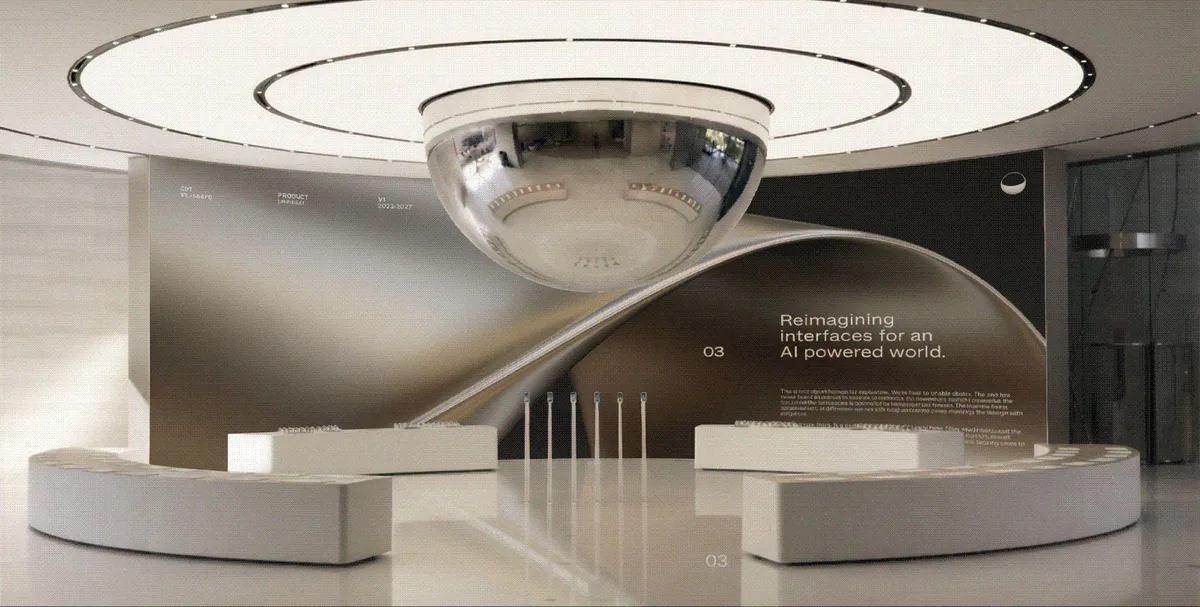
Aina
Identity exploration for a company building interfaces that work out what you need before you ask, then wait for a yes.
Context
Aina is building toward the interaction models that might be normal in ten or fifteen years. Instead of asking people to navigate, search, type and manage screens, the system works out the few things a person is likely to need next and puts them up for approval.
Almost every interface in use today was designed around the limits of human hands. Keyboards, mice, taps, swipes, menus. They ask a person to translate what they want into a sequence of inputs.
The useful way to think about the brief came from the client. This is not another interface. It is closer to the invention of the mouse: a new mechanism that makes a new kind of behaviour feel obvious.
Approach
The idea we worked from is that Aina is a mirror. It reads your patterns, reflects back what you need, and takes the sorting and preparing off you while leaving the decision with you. Prediction, with permission.
Three territories tested different readings of that. Material Intelligence put it in machined metal, modular components and reflective surfaces. Surgical Precision made it about reduction, exposed engineering and tolerances. Prismatic Futures made it about refracted light and shifting planes, prediction as something ambient.
The logo ran through four routes and the most useful thing to come out of them was what got rejected. A modular wordmark had the right personality and read as gaming. An angular, encoded route read as automotive. The note that cracked it was that the mirror had to live in the form logic rather than in a picture of a mirror, and that the A, which appears twice, could anchor the whole system.
What the project produced is a set of guardrails rather than a finished mark. Reflection as symmetry and axis instead of as an icon. A logomark and wordmark built from one construction system. Two states, solid and outline, so the identity carries the yes and the no.